
 Become a TechRadar Insider





Computex 2026 happened this week, and the computing extravaganza brought with it a raft of interesting hardware revelations, questions and commentary. As well as the shiny new gadgets, some of the speeches or interviews given by key players in the tech industry made us all sit up and take notice — and below we've picked out the five most pertinent quotes that tell us about the future of computing.
From Qualcomm's boss through to Nvidia's leather jacket-toting chief, we heard some weighty utterances, and there was no shortage of talk around one particular subject. AI wasn't the only topic mentioned regarding the future of computing, though — thankfully — as you'll see, but there's no denying it was a very prominent subject indeed.
1. "Resistance is futile" (Cristiano Amon, Qualcomm)

No, the Borg didn't turn up at Computex 2026 this year (though sources tell me there's a mysterious cube-shaped booth booked for 2027), but rather it was Cristiano Amon, the chief executive at Qualcomm, who told us that "resistance is futile".

What should we not waste our energy resisting, then? Well, predictably enough it's the inevitable advance of AI, and more specifically, Amon sees the irresistible force that'll pervade our lives as AI agents.
As The Register reported, the Qualcomm CEO believes that in the future, these agents – fancy AI bots that will automate tasks, do things for us, and organize our lives – will have their tendrils everywhere, in all our devices.
From your phone to your earbuds to your smart glasses (if big tech's campaign to make the latter an acceptable gadget succeeds), all of this hardware will feed data of one kind or another to the AI agent.
Amon explained: "The agent isn't tied to the device, it actually moves with the user. It's there with the user, regardless of the device that you have. Once you understand that change, you understand how the whole mobile industry is going to change."
In short, we're all going to turn into walking sensors and cameras, with 6G connectivity enabling all this to be piped back to AI which will gorge itself on this data – all for our benefit, of course. (Ahem – what could possibly go wrong?)
The 'camera' reference isn't mine, by the way, as Amon explicitly stated: "If you have smart glasses, they see what you see, so the connectivity needs to enable a very fast uplink. 6G is going to make all of us into walking cameras in this world."
Don't want your every waking moment, and probably your sleeping moments too, to be shadowed by AI? Hate this idea with every fiber of your being? Well, tough, because Amon explains that this vision of the future – which is seemingly inevitable, as this is where the "resistance is futile" remark was made – can only work by leveraging the power of all our devices.
These sophisticated agents can't be run only in the data center, and so future devices— with ever-more powerful CPUs, and of course NPUs for local AI acceleration — will take the load off with on-device processing in various degrees. And unsurprisingly, Qualcomm's hardware, in various forms, will figure in this dystopian-sounding future of omnipresent surveillance.
2. "Our goal is to deliver unmetered intelligence to every home and every desk with Windows" (Satya Nadella, Microsoft)
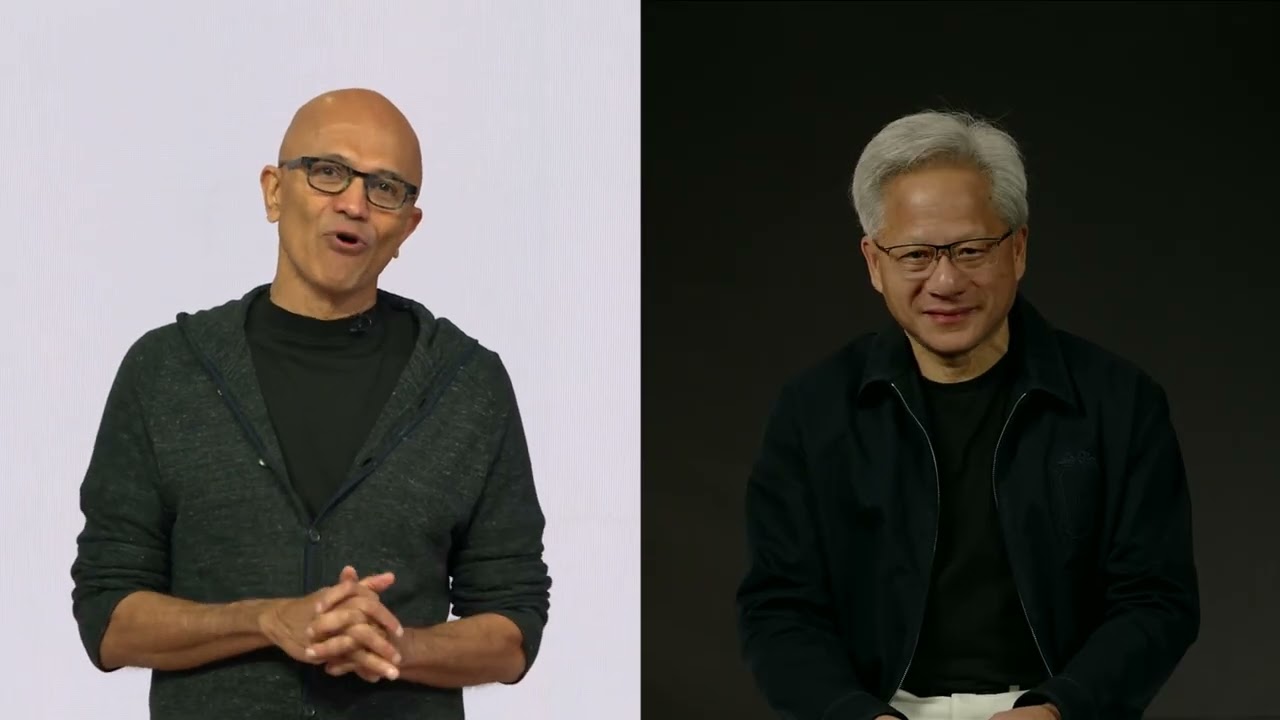
Qualcomm's chief exec wasn't the only CEO to be heavily pushing AI, and to no one's surprise, Satya Nadella got in on the act here. As part of Computex 2026 – or GTC 2026 Taipei therein, strictly speaking – Microsoft and Nvidia got together for the big reveal of Team Green's RTX Spark Arm-based 'superchip' which is set to drive the reinvention of the Windows PC, no less.
I'll come on to Nvidia's big quote on this project next, but Microsoft had two telling soundbites for us, one of which was from Nadella, who observed: "Our goal is to deliver unmetered intelligence to every home and every desk with Windows. RTX Spark marks a real breakthrough towards that vision."
Unmetered intelligence refers to AI, and elsewhere, Microsoft's head of Windows, Pavan Davuluri, talked about a new chapter for Windows PCs, and said: "We are building toward a future where Windows provides a unified foundation for AI, from the device in your hands to the infrastructure behind it."
So, while Microsoft has promised to cut back on AI as part of the big drive to fix Windows 11, that may mean that some Copilot options are pared back from various menus – but it absolutely doesn't mean that Microsoft is minimizing AI within the OS. As we see from these quotes, when it comes to AI agents – with agentic AI being something Microsoft has been pushing in a big way of late – Windows is very much being developed with these firmly in mind.
Much like Qualcomm's Amon, Nadella envisions AI being present in every home — and on every desk — thanks to Windows devices. (And again, are you distinctly not stoked about that idea? Well, don't worry, AI will surely be happy to listen to your feedback).
3. "We're really focused on doing something that is just such a big deal, reinventing the PC after 40 years" (Jensen Huang, Nvidia)

Naturally, Nvidia's boss had some weighty quote material to throw around at Computex 2026, and the highlight for me pertained to the Arm-based RTX Spark CPU (as mentioned above).
Huang said: "We're really focused on doing something that is just such a big deal, reinventing the PC after 40 years."
Of course, this is a collaborative venture between Nvidia and Microsoft, who according to the joint press release for the project, want to "reinvent Windows PCs for the age of personal AI".
It is, of course, a big move for Nvidia to launch a new processor for the PC, the gravity of which is reinforced by the kind of changes Microsoft is making to Windows 11 for this chip. We're talking about specific optimizations in Windows 11 for Nvidia RTX Spark, and not small moves either – sizable changes, some of which advance the cause of all Arm CPUs (like Qualcomm's) considerably with the OS. That includes a drive to support more software with Arm-based Windows 11 devices, and even to improve game compatibility (with some notable anti-cheat stumbling blocks being resolved).
As it happens, Huang's above quote actually came as part of a response to a question about whether a gaming handled might be made with the RTX Spark CPU. As PC Gamer reported, the full quote was: "If somebody wants to do it [a gaming handheld], you know, we'll work with them on it. But right now we're really focused on doing something that is just such a big deal, reinventing the PC after 40 years."

So, the idea of a handheld was brushed aside, as what this is all about, really, is that 'reinvention' of the PC around AI.
As Huang further enthused: "Can we help reinvent the PC? And, boy, if you get a chance to reinvent the single most important instrument, the single most important tool of humanity, what you and I grew up with defined just about everything about our lives, and we have an opportunity after 40 years to go reinvent it for the age of AI. Wow, we're not going to sit around, not let it get done."
When you put this together with Nadella's comment, and Amon's vision of the AI-centric future, there was a clear vibe at Computex 2026: agentic AI is coming, and you might as well accept this now.
Of course, more than most, Huang has a vested interest in promoting this line of thinking. Nvidia's done quite well out of AI so far, I believe.
4. "We know the pressures that are there in building systems aren't going away anytime soon" (David McAfee, AMD)

Not everything about the future of computing at Computex 2026 revolved around AI, of course, and there was some commentary on the dire situation around PC component price hikes — and what might be done about that going forward.
When questioned about why AMD had just released a last-gen 3D V-Cache processor as an alternative budget offering — as a reaction to rising PC build costs — rather than a current-gen Zen 5 model, AMD's VP and general manager of Ryzen CPU and Radeon Graphics, David McAfee, had something pertinent to say.
McAfee teased: "I think as we go through the rest of this year, I mean we're always looking for ways to, you know, create as many options as we can, and that [Zen 5 X3D CPU] may become… maybe something that we look at doing as a runway product later this year, simply because you know we know the pressures that are there in building systems aren't going away anytime soon."
So, we may see a Ryzen 5 9600X3D CPU (or similar) emerge as an affordable engine for a gaming rig later this year.
More broadly, this is a signal that AMD is actively thinking about how to help ease the demands that price hikes on RAM, storage, CPUs and GPUs (and more besides) are exerting on the wallets of consumers. Although it also serves as a depressing acknowledgement that pricing woes aren't going away for quite some time yet.
It was also good to see AMD underline its commitment to the AM5 chipset with support guaranteed through to 2029 at Computex, for those who aren't planning on building a new PC anytime soon. Waiting out the worst of the pricing crisis may well be the best approach, frankly, if that's a viable option in your circumstances.
5. "Longer term, I think something has to give, right? The over-inflation, we will have to keep an eye out" (Nish Neelalojanan, Intel)
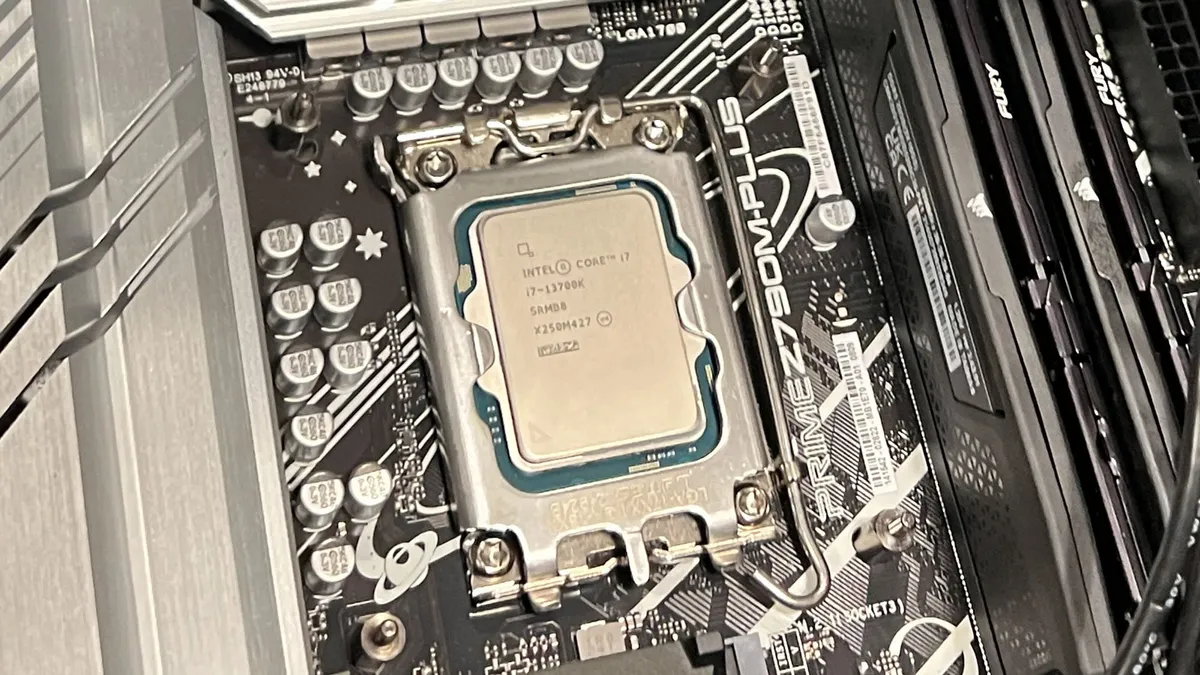
Like AMD, Intel also had thoughts on the current PC component pricing nastiness which it shared at Computex 2026.
Specifically, in a chat with Tom's Hardware, Intel's Nish Neelalojanan, who is senior director of product management for client computing, said of the RAM supply crisis and spiking costs: "Longer term, I think something has to give, right? The over-inflation, we will have to keep an eye out."
Neelalojanan elaborated on this, noting that Intel was adapting its strategy to help frustrated consumers in terms of maintaining support for last-gen (DDR4) memory and older (more affordable) CPUs. The exec noted: "We do have products that support DDR4 on both desktop and mobile. Raptor Lake [13th-gen CPUs that first emerged in 2022], we're not end-of-life-ing any of them; they're there. We'll continue to make sure that there are products which can take care of older memory technologies if they're available and cheap."
With laptops, Neelalojanan pointed to Intel's new Wildcat Lake mobile silicon, of which the exec promised "we are validating lower configs", meaning lower-end notebooks starting at 8GB RAM.
Neelalojanan said: "Wildcat Lake is a single-channel product, so there are products which can leverage low memory and give reasonably good performance."
This range of mobile silicon does indeed seem like a promising addition for more affordable laptops, and so it's not all bleak news for the future of PCs in terms of the undoubtedly painful price hikes we've all sadly become accustomed to.

➡️ Read our full guide to the best laptops
1. Best overall:
Apple MacBook Air 13-inch M5
2. Best budget:
Apple MacBook Neo
3. Best Windows 11 laptop
Microsoft Surface Laptop 13-inch
4. Best thin and light:
Lenovo Yoga Slim 9i
5. Best Ultrabook
Asus Zenbook S 16

Follow TechRadar on Google News and add us as a preferred source to get our expert news, reviews, and opinion in your feeds.