


- Register.si logged 19,541 new .si names in 24 hours, about five times its pre-order daily pace
- India (3,174) edged the US (3,135) in Hostinger's data, with Morocco a surprising third on 678
- Hostinger handled roughly two in five new .si names on September 30 and October 1 2026, and says its sales peaked October 5 before cooling to about 4x pre-order levels
The scramble for Slovenia's .si domain has not burned out just yet: on October 9 2026, the live counter on the Register.si homepage showed 19,541 new .si names registered in the preceding 24 hours.
This is roughly five times the average of about 3,700 a day the registry logged in the week between President Trump's UN speech and his executive order.
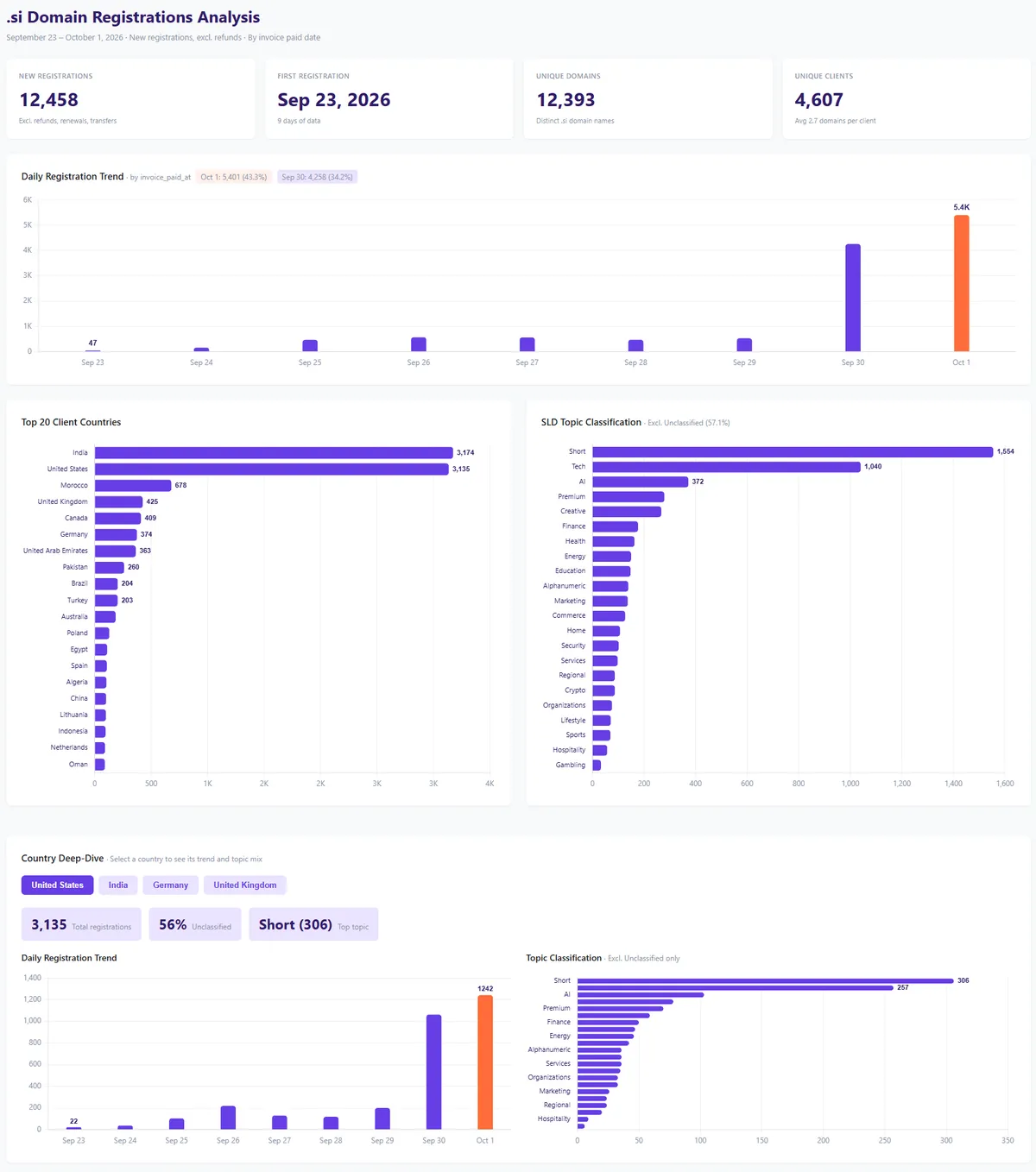
The usual assumption would be that this is an American land grab of virtual real estate, but data from Hostinger, one of the biggest retail sellers of the extension, complicates that picture considerably: across the nine days its dashboard covers, customers in India registered 3,174 .si names against 3,135 from the US, a gap of just 39 even as Morocco comes a distant third.
A domain rush concentrated on short names
The gold rush started at the UN General Assembly on September 22 2026, where President Trump said the US government would start calling AI "super intelligence," or SI.
A week later, he signed Executive Order 14434, "Inaugurating the Era of Super Intelligence," which tells federal agencies to swap in the new terms and says the executive branch "will not acknowledge the use of 'Artificial Intelligence' and 'AI.'"
That label happens to match Slovenia's country code, in use since 1992; anyone can register a .si name without a Slovenian address, and it can be bought for a single year, while Anguilla's .ai requires a two-year minimum.
With a much lower barrier to entry, scalpers and opportunists alike have flooded in, targeting domain names across the board, most aiming for a quick flip if the .si domain name catches on.
The registry's own numbers show how fast things moved. Register.si recorded 3,515 new .si domains in all of August and 46,066 in September, about 13 times as many. Its daily chart, as seen on XenoSpectrum, shows 4,115 registrations on September 29, the day the order was signed, then 11,331 on September 30 and 12,728 on October 1.
A domain rush concentrated on short names and a surprising number of Indian buyers
Hostinger's country table, which it shared exclusively with TechRadar Pro, is where the story gets interesting. India accounted for 25.5% (3,174) of its .si registrations and the US for 25.2% (3,135), together just over half, matching what the company told TechCrunch.
Morocco followed at a distant 3rd with 678, ahead of the UK (425), Canada (409), Germany (374) and the UAE (363). Pakistan ranked eighth with 260, and Egypt and Algeria also made the top 20.
What buyers are choosing is just as revealing. Hostinger could not classify 57.1% of the names. Among the rest, short names led with 1,554, followed by tech-themed names at 1,040 and explicitly AI-themed names at 372.
That is a ratio of about 4.2 to 1 in favor of short names, and AI names made up only 3% of all .si registrations in the period. US buyers followed the same pattern, with short names their top category at 306.
Plenty of evidence points to speculation; Netcraft found that just over half of the .si names it saw registered at Dynadot between Trump's Truth Social poll and his UN speech were promptly listed on Dynadot's resale marketplace.
It also found 87 .com names pairing household brands with "superintelligence," registered hours before the order was signed and listed at $20,000 each, though it saw no evidence any had sold.
Names like build.si carry seven-figure asking prices, and of 35 publicly documented .si sales in the first half of 2026, only two went to companies that actually use the domain, including AI startup Recursive, which paid $20,000 for recursive.si.
The problem (or rather the opportunity) isn't really a problem: registration is cheap. Hostinger charges $11.99 for the first year and $16.99 to renew, and Register.si takes €10 per domain. This allows anyone with $1200 to spare (sans any coupon discounts they might be able to find) to essentially be able to hoard, squat, or scalp, depending on the terminology one prefers, as many as 100 domains without much to worry about.
Domain Name Wire estimated the September surge brought the registry around €300,000 in extra revenue, arguably chump change next to the roughly $85.3 million Anguilla earned from .ai in 2025, per CircleID.
The real question is how many of these names survive their first renewal in late 2027. If "SI" stays a White House term while the rest of the industry keeps saying AI, a large share of this year's speculative registrations will quietly lapse. The 60-day deadline for a formal federal definition could reshape that calculation either way, even as the Trump administration remains adamant that the change will be increasingly visible in the days to come.

Follow TechRadar on Google News and add us as a preferred source to get our expert news, reviews, and opinion in your feeds.
